How to Make Money Designing T-Shirts
You do not need a warehouse, printing press, or fashion degree to make money designing T-shirts. You need a clear audience, original artwork, reliable production, and a sensible way to reach buyers. A good shirt helps someone show what they enjoy, believe, or share with a community.
Print-on-demand has made the entry cost much lower. A fulfillment company can print and ship your design after a customer orders, removing the risk of buying dozens of shirts before you know what will sell. Research, quality control, and marketing still matter.
How a T-Shirt Design Business Makes Money
There are three common business models, and you do not have to choose only one forever.
Print-on-Demand
With print-on-demand, or POD, the shirt is produced only after an order is placed. The supplier charges you for the blank garment, printing, and fulfillment; you keep what remains after those costs and selling fees. According to Printful’s explanation of the model, the provider can also pack and ship the order directly to your customer.
POD requires little inventory investment, but margins are lower and you have less control over packaging and production.
Small-Batch or Bulk Printing
Once a design has proven demand, a local screen printer may reduce the cost per unit and give you more control. You pay upfront, however, and can be left with unsold sizes or colors. Treat bulk printing as a second step, not a guess.
Selling Design Services or Licenses
You can also design merchandise for bands, schools, businesses, clubs, events, and online creators. Charge for print-ready files or license an illustration for a limited run. This can produce income sooner because the client pays for the creative work.
Choose a Specific Audience Before You Start Designing
“Funny shirts” is not a useful niche. “Funny shirts for night-shift nurses” is much easier to understand and market. Specific audiences give you recognizable language, shared experiences, and natural places to promote your work.
Possible starting points include hobbies, professions, regional pride, pets, family roles, outdoor activities, gaming communities, or small clubs. You should understand why someone in that group would wear the design in public.
Study marketplace results, customer reviews, community discussions, and social media comments. Look for themes that receive attention, then identify what existing products miss. Do not copy bestsellers. Use research to understand the buyer, not to trace another seller’s work.
Create Designs That Work on Fabric
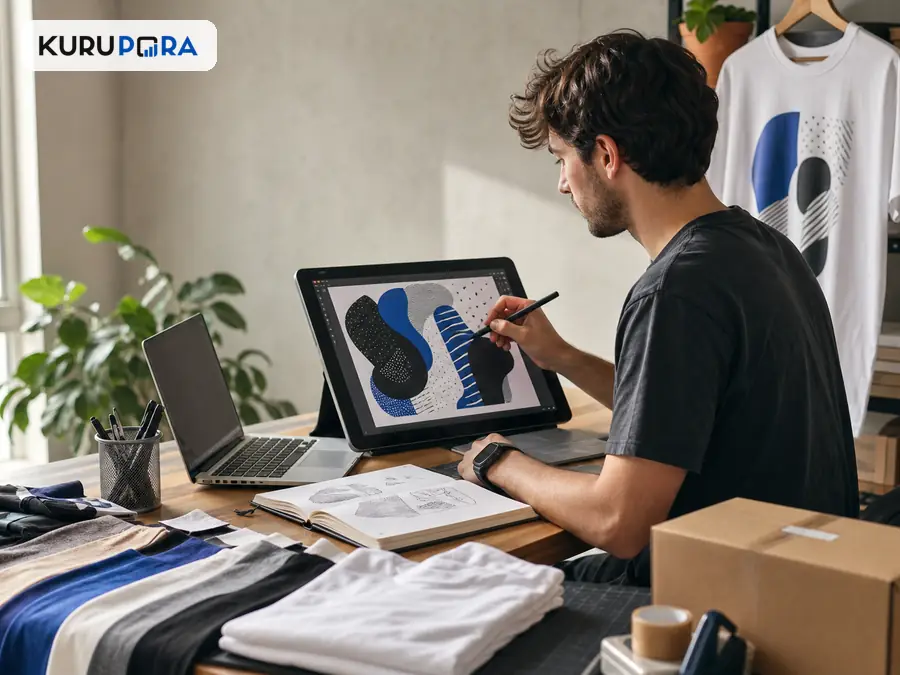
A detailed illustration can look impressive on a monitor and still print poorly on cotton. Strong T-shirt designs usually have a clear focal point, readable type, controlled colors, and enough contrast against the garment.
Start with compositions that remain recognizable from several feet away. Test black, white, and one or two garment colors rather than offering every possible option.
Follow the print provider’s file template. Many workflows use a high-resolution PNG with a transparent background, while vector artwork is useful when the design must be resized. Check the required dimensions, color profile, printable area, and minimum line thickness before uploading. Small errors around transparent edges can become obvious when printed.
Order a sample before promoting a design heavily. Check the fabric, fit, print placement, color accuracy, and appearance after washing. Mockups sell the idea; a sample shows what the customer will receive.
Choose Where to Sell Your T-Shirts
Marketplaces such as Etsy, Amazon Merch on Demand, and Redbubble provide an existing audience. They are convenient for testing, but competition is intense and each platform has its own rules and fees.
A Shopify or WooCommerce store gives you greater control over branding and customer relationships, but it does not come with traffic. A practical approach is to validate products on a marketplace while building your own website and email list.
Begin with 10 to 20 related designs instead of uploading hundreds of random ideas. A coherent collection makes it easier to see which themes and styles attract buyers.
Price for Profit, Not Just for Sales
Your price must cover production, selling fees, any shipping contribution, advertising, refunds, tools, and taxes.
For example, suppose a shirt sells for $28. Production and printing cost $12.50, platform and payment fees total $3, and you contribute $2.50 toward shipping. That leaves $10 before advertising, returns, software, and tax. This is only a sample calculation; your actual costs will depend on the garment, supplier, country, and sales channel.
Use this basic formula:
Profit per shirt = selling price − production − selling fees − shipping contribution − advertising cost
A low price may leave no room for replacements or promotions. Compete through relevance, quality, and presentation instead of being the cheapest seller.
Build Listings That Answer Buying Questions
Your product title should describe the audience and design naturally. Use relevant search phrases without making it unreadable. Explain the fit, material, print method, sizes, care, production time, and return policy in the description.
Use several images: a clean front view, a close-up of the artwork, a lifestyle image, available colors, and an easy-to-read size chart. If your mockup makes the print appear larger or more vivid than it really is, customers may feel misled. Accurate expectations reduce complaints.
Market the Story Behind the Shirt
Show sketches, color tests, samples, packaging, and the reason behind a collection. Short process videos can make a small brand more memorable than repeated product images.
Create content where your audience spends time. A hiking design might suit outdoor groups, while a teacher shirt may perform around school-year milestones. Participate in the community instead of appearing only to post a sales link.
For paid advertising, begin with a small test budget and one proven product. Track profit after advertising rather than celebrating revenue alone. If a $28 sale costs $12 in ads while your pre-ad profit is $10, the campaign is losing money.
Protect Your Work and Avoid Legal Problems
Do not use sports logos, movie characters, song lyrics, celebrity images, brand names, or artwork found through an image search unless you have permission or a valid license. A phrase that sounds ordinary may also be protected as a trademark for clothing.
Search relevant trademark databases before committing to a slogan or brand name. The USPTO explains that trademarks can include words, phrases, symbols, or designs used to identify the source of goods or services. If you plan to build a serious brand or are unsure about a design, consult a qualified intellectual-property professional in your country.
Keep dated source files, sketches, license receipts, and client agreements as evidence of your work and permissions.
A Practical 30-Day Starting Plan
During the first week, choose one audience and study what its members buy, discuss, and complain about. In week two, create several concepts and turn the best three to five into print-ready designs. During week three, order samples, prepare mockups, calculate prices, and write complete listings. Use the final week to publish a small collection and promote it with useful niche-specific content.
The first month is for learning which ideas earn clicks, convert, and satisfy customers. One design with genuine demand is more valuable than a hundred untested slogans.
Frequently Asked Questions
Can Beginners Make Money Designing T-Shirts?
Yes, but artistic ability is not enough. Choose a narrow audience, create original work, order samples, calculate every cost, and publish a consistent collection.
How Much Does It Cost to Start?
A POD business requires relatively little money because you do not purchase inventory in advance. Budget for samples, selling fees, optional software, a domain, and initial marketing. Bulk printing needs more upfront cash.
Is a T-Shirt Business Passive Income?
Not at the beginning. Research, design, listings, customer service, and marketing require regular work. A successful catalog may produce repeat sales later, but it still needs monitoring.